
Quick Summary
A giraffe barn encounter feels personal because of how it is structured. Open pasture settings, small groups, and unhurried hand feeding replace the glass and crowds of a typical zoo, letting animals set the pace instead of a fixed schedule. At Artemis Ranch & Retreat, that approach pairs with real conservation work, giving each encounter a sense of purpose beyond entertainment. The result works well for families, couples, and multigenerational groups, turning a brief wildlife stop into one of the most memorable parts of the stay.
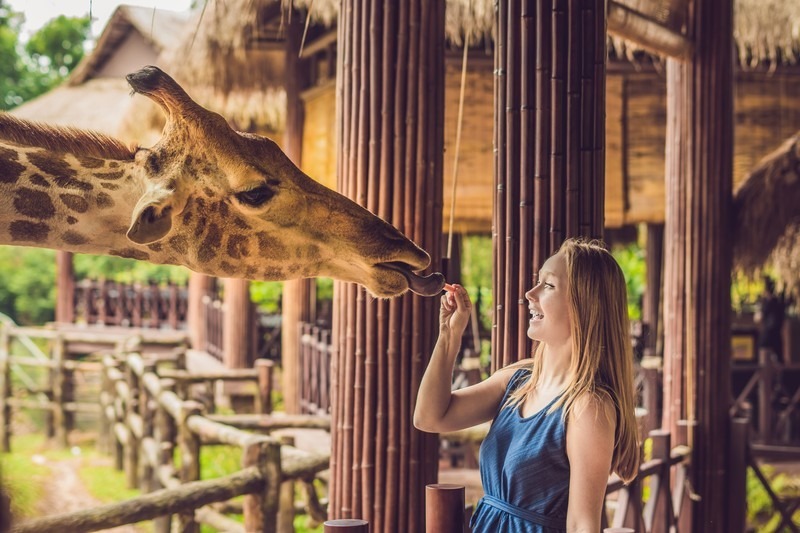
Standing near the giraffe barn at Artemis Ranch & Retreat, the first thing most guests notice is how quiet it is. There is no glass, no crowd pressing in from either side, and no rope line dictating exactly where you can stand. Just open air, a giraffe leaning down at its own pace, and a handful of other guests waiting their turn.
That kind of setting changes the entire nature of a wildlife encounter, and it is a big part of why visitors describe their time at the ranch as something closer to a real connection than a typical outing.
Space Changes the Way an Encounter Feels
Traditional zoos are built around efficient viewing, moving large numbers of visitors past enclosures as smoothly as possible. That model works for volume, but it rarely allows for a slow, unhurried moment with an animal. At Artemis Ranch & Retreat, the giraffe barn and surrounding pasture were designed around the opposite idea, giving each small group time to approach, observe, and interact without a line forming behind them.
Because the herd roams across open acreage rather than a fixed enclosure, the animals themselves set the pace of the encounter. Guests are not waiting for an animal to appear on cue, they are meeting it on its own terms, which tends to make the moment feel earned rather than staged.
Hand Feeding Builds a Different Kind of Connection
Few wildlife destinations in Texas allow guests to hand feed a giraffe at close range, and fewer still do it in a setting this open. Reaching up to offer lettuce or crackers while a giraffe lowers its head toward you creates a moment of trust that is hard to replicate from behind a barrier. Guides are on hand throughout to explain feeding behavior, answer questions, and make sure both guests and animals stay comfortable.
For many visitors, this is the single moment they remember most from their stay, not because it is dramatic, but because it feels genuinely reciprocal. The giraffe is choosing to approach, not performing on a schedule. There is also a physical scale to the interaction that surprises most first time guests. Standing at eye level with an animal that can tower well over fifteen feet tall, even for a few seconds, tends to leave a stronger impression than an entire afternoon spent watching from a distance.
What Makes the Ranch’s Approach Different From a Zoo
Most zoo encounters are built around containment, with barriers designed to protect both the animal and the visitor from unplanned contact. That structure is necessary in an urban setting, but it also creates distance, both physical and emotional. Artemis Ranch & Retreat operates differently because the land itself allows for it.
Thousands of acres of native habitat give the herd room to roam, graze, and behave naturally, which means guests are observing real behavior rather than a routine shaped entirely by an enclosure.
Guides play a large role in bridging that gap as well, translating what guests are seeing into context, from feeding habits to social behavior within the herd, so the encounter becomes educational without ever feeling like a lecture.
Small Groups Instead of Large Crowds
Group size plays a large role in how personal an encounter feels. Artemis Ranch & Retreat keeps wildlife sessions intentionally small, which means guides can tailor the pace to the group rather than rushing everyone through on a fixed schedule. Families traveling with young children, couples on a wedding weekend, and larger gatherings can each move through the experience differently depending on what they want to get out of it.
This smaller scale also means more direct interaction with guides, who often share details about individual animals in the herd, including personality quirks and history, that get lost in a larger, more anonymous setting.
A Setting Built on Conservation, Not Display
The giraffe barn is not simply an attraction, it is part of a broader conservation effort that defines the property’s mission. Every encounter supports habitat restoration and species protection work happening across the ranch, which gives the experience a sense of purpose beyond entertainment. Guests are not just observing wildlife, they are contributing to its continued care.
That distinction tends to shift how people approach the encounter itself. Visitors who understand the conservation work behind the scenes often describe feeling more present and more attentive during their time with the herd, rather than treating it as a quick photo stop.
Why it Resonates With So Many Kinds of Guests
Because the experience is calm and self paced, it tends to work well for a wide range of visitors. Multigenerational family gatherings find it approachable for grandparents and grandchildren alike, while couples often list it among the more memorable parts of a longer stay. It is a rare kind of activity that does not need to be simplified for younger guests or amplified for adults, since the encounter itself carries enough weight on its own.
The latest news and updates from the ranch regularly features stories from the herd, including new arrivals, which gives returning guests something to follow between visits and adds another layer of personal connection to each trip.
Planning Your Own Visit
If a closer, quieter wildlife encounter sounds like what your trip is missing, our team can help you build a stay around it. Start planning your retreat and we will walk you through timing, group size, and the best way to fit a giraffe barn visit into your itinerary.